Apex
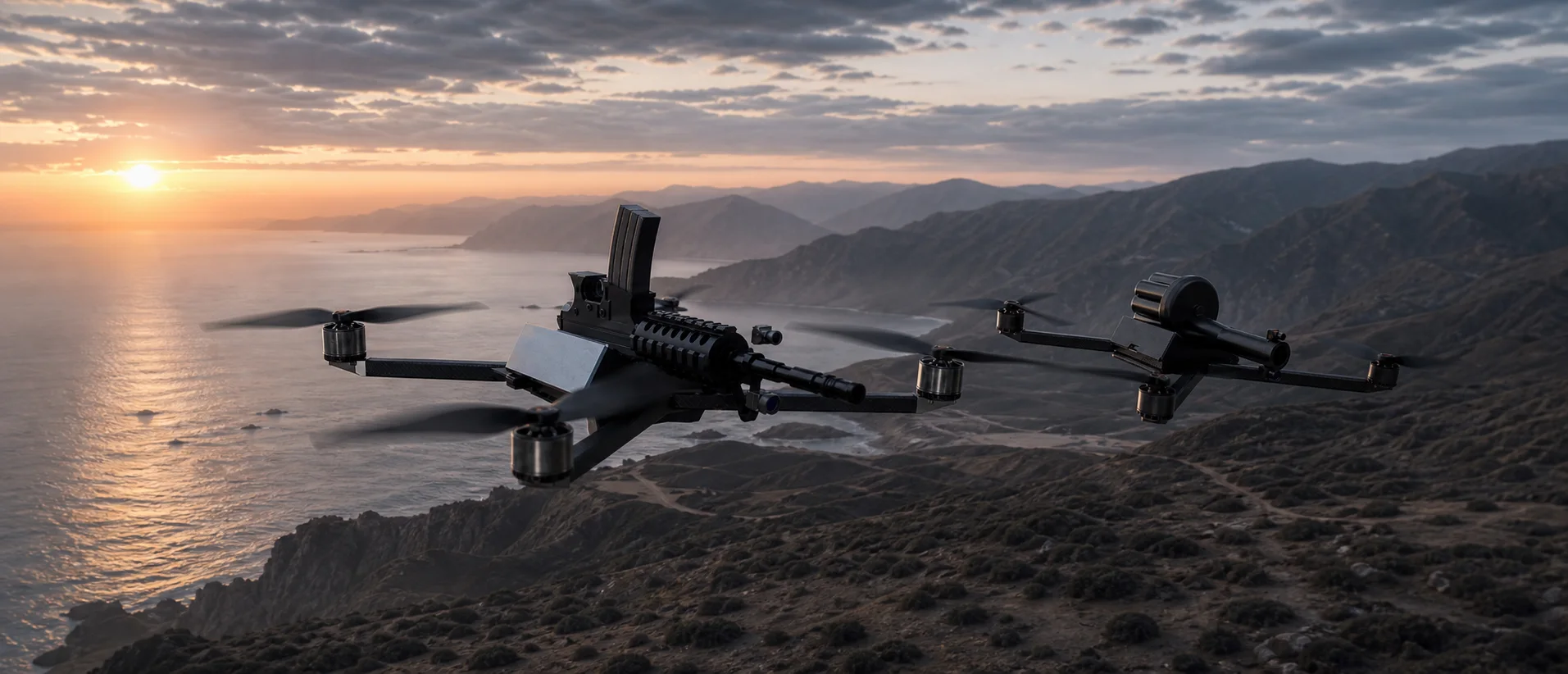
A reusable armed multirotor designed around the effect line, with direct-fire and launched-effect versions.
- Effect
- Direct-fire effect
- Launched effect
A reusable armed multirotor built around the effect, not around a later attachment.
Apex aligns the aircraft’s center of mass, thrust axis and effector reference so firing or release forces act through the airframe with less unwanted rotational moment. The same reusable platform supports a direct-fire configuration and a launched-effect configuration.
The problem with bolt-on effectors
An effector mounted below or beside an existing aircraft creates offset loads. Those loads rotate the platform, separate the sensor’s believed aim from the actual effect line, and force software or a gimbal to correct a geometry problem after it has already been created.
Apex begins with the effect line. The airframe, flight controller reference, structure and mission interface are organized around it from the start.
Shared aircraft architecture
The Apex airframe combines four mechanisms:
- Collinear geometry: center of mass, center of thrust and the effector reference share one primary axis.
- Rigid aim reference: the effector and inertial reference connect through the same load-bearing structure.
- Airframe-as-aiming: the aircraft establishes the firing or release solution through its flight path rather than depending on a large stabilized mount.
- Onboard fire-control state: Sentinel accounts for the selected effector and changes in carried mass throughout the mission.
These mechanisms turn the airframe and effect into one controlled system.
Two configurations
Apex-G — direct fire
Apex-G integrates a direct-fire effector with the collinear aircraft structure. It uses a controlled pass to establish the firing window while Sentinel maintains the target track and aircraft state. The operator authorizes each engagement.
Apex-L — launched effect
Apex-L carries a launched munition through the modular mission interface. The aircraft approaches the release condition, supports operator confirmation, releases the approved effect and returns for re-arming. If the effect is not authorized, the aircraft can abort and return with it retained.
Why reusable effect
Attritable aircraft remain the right answer for many one-way missions. Apex addresses a different operating pattern: repeated sorties, persistent presence, deliberate target confirmation and the ability to return without releasing an effect. Reuse shifts the mission from one airframe per engagement to one platform supporting multiple authorized engagements.
Common advantages
- Geometry before correction: the airframe reduces offset-force problems at the structural level.
- One base platform, two effect paths: direct-fire and launched-effect configurations share the same aircraft and operator system.
- Reusable operating model: the platform returns after a direct-fire mission or launched-effect delivery.
- Effector-aware Sentinel: onboard tracking and aircraft-state logic are configured for the installed effect.
- Abort without effect: the operator can withhold authorization and recover the aircraft.
- Modular mission interface: effect configurations connect through a tier-matched mechanical, power, data and authorization pattern.
Sentinel and human authority
Sentinel provides visual tracking, navigation, aircraft-state estimation and the engagement workflow. Lethal effect remains human-in-the-loop. A hardware authorization boundary separates effect release from aircraft control, and mission abort remains available. Apex does not autonomously select and engage individual people.