Sentinel
The autonomy and command architecture connecting platform, operator and mission.
Autonomy and command architecture
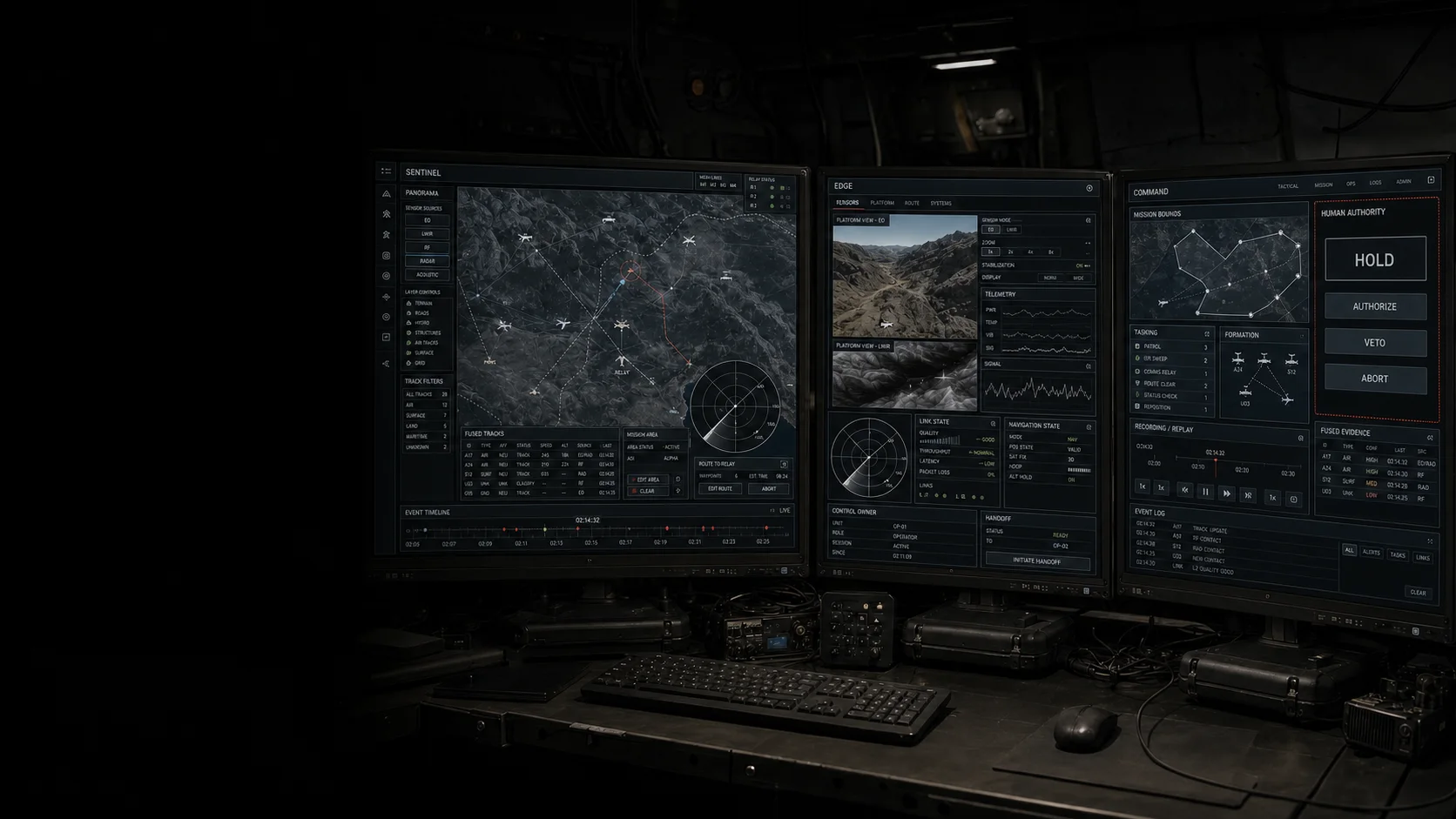
Sentinel brings on-platform compute, networking, sensor fusion, human command and fleet-level planning into one architecture spanning air, ground and maritime systems.
Architecture
Five layers, one operating chain.
Edge
On-platform compute supports perception, navigation and guidance where the mission happens. Keeping key functions on the vehicle reduces dependence on continuous remote processing.
Mesh
Platforms, ground nodes and sensors exchange position, health and mission information across a shared network. Relay extends the network as an airborne backbone node.
Fusion
Inputs from the fleet and connected sensors are correlated into one common operating picture. Panorama presents that picture at the ground side.
Command
Operators task platforms, define mission bounds and retain authorization and abort authority. Command is the point where human intent enters the system.
Strategy
Fleet-level planning coordinates platforms and mission roles around the commander’s defined objectives and rules of engagement.
Common architecture
A shared system reduces repeated integration.
The same architecture appears differently on each platform. A compact FPV airframe carries a smaller edge and communications footprint than a larger ISR or relay platform, but both participate in the same system model.
Common interfaces allow sensors, payloads, operator equipment and software changes to be introduced without redefining the entire portfolio. Platform-specific configurations remain bounded by size, mission and payload tier.
Human command
Intent remains at the point of use.
Sentinel missions are bounded by time, geography, target class and rules of engagement. Operators take positive action to authorize relevant engagements and retain mission-abort authority. The network does not pass engagement authority laterally from one platform to another.
The public commitment is simple: no unauthorized engagement.
Operator system
One picture, tasking and oversight.
Panorama, the ground segment, Merlin TX and Tairos operator equipment turn Sentinel into an operator-facing system. The goal is to reduce the number of isolated feeds and controls an operator must manage while keeping state changes and authority visible.
Integration
Platforms and third-party inputs meet at defined interfaces.
Sentinel’s interface model covers Tairos platforms, Relay nodes, ground systems and external sensor or command inputs. Integration work should begin with the mission data, authority boundary and operating environment, then select the appropriate platform and link configuration.
Connected portfolio
- Effect: Dart · Strix · Apex · Nova-S · Corvus
- Awareness: Iris
- Contest: Nova-I · Picket · drone detection · EW soft-kill
- Sustain: Atlas
- Backbone: Relay · Panorama · ground segment · operator equipment
- Cross-domain: UGV · USV · UUV