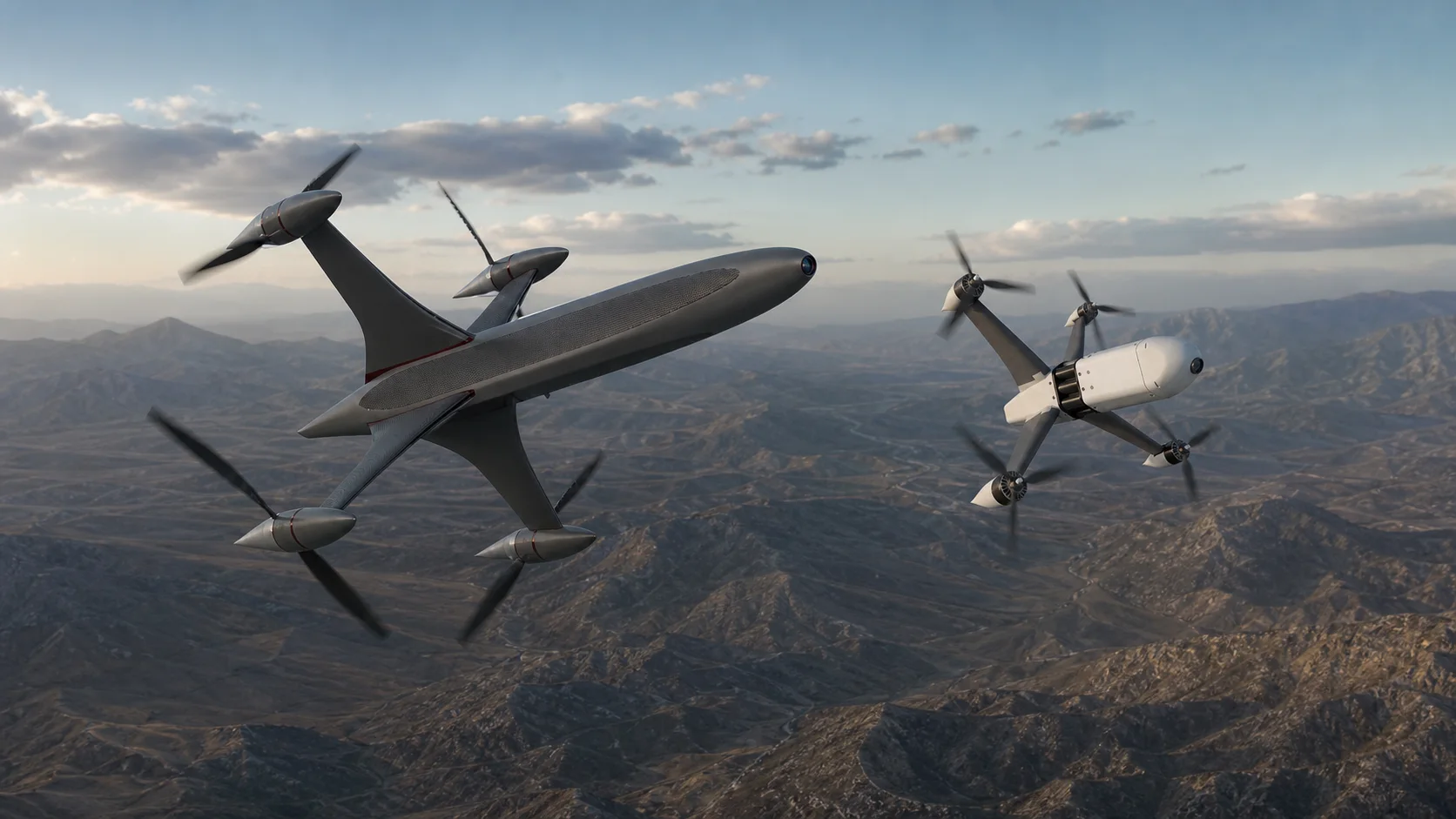
Nova
One public fixed-wing dossier with separate Nova-S loitering-effect and Nova-I counter-air series.
- Effect
- Contest
- Loitering effect
- Counter-air intercept
Nova brings two mission branches under one platform doctrine. Nova-S provides loitering strike from the front-to-mid fight through operational reach. Nova-I provides a dedicated counter-air response to one-way attack drones.
The operational problem
Strike and counter-air demand different flight profiles, terminal tasks and payloads. They still need to work inside the same command structure. Nova separates the airframes by mission while keeping autonomy, operator authority and system integration consistent through Sentinel.
Two branches
Nova-S — reach and effect
Nova-S is the loitering-strike branch. Its three-member agile line scales the near and mid fight by airframe class. Nova-S LR 150 shifts the physics toward efficient flight and longer operational reach.
Models: Nova-S 1 · Nova-S 2 · Nova-S 3 · Nova-S LR 150
The agile line prioritizes responsive control and terminal maneuvering. Nova-S LR 150 gives more of the airframe’s energy budget to efficient travel and time over the mission area. The separation is deliberate: no single airframe can maximize agility, endurance and reach at once.
Nova-I — contest
Nova-I is the fixed-wing interceptor branch. It is scoped to one-way attack drones, with a baseline volume interceptor and an extended-envelope configuration for the harder end of that threat class.
Models: Nova-I 1 · Nova-I 2
Nova-I is not positioned as a general-purpose air-defense missile or as the answer to every small-drone threat. Inside Picket, sensor tracks enter Sentinel Fusion, the operator retains launch authority through Sentinel Command and the authorized intercept remains inside a bounded mission envelope.
Shared architecture
Every Nova configuration operates through Sentinel. Edge autonomy supports the airframe, Mesh connects it to other nodes, Fusion assembles the operational picture and Command preserves human tasking and authorization.
Nova-S payload integration follows Tairos’s shared modular-integration principle. Interfaces are scaled by payload class so common engineering and safety logic carry across compatible platforms without pretending that one physical module fits every airframe.
Advantages
Mission clarity
Strike and intercept remain separate branches, each optimized for its own geometry and target class.
One command environment
Operators do not need a separate operational picture for each Nova role. Sentinel connects the family to the wider Tairos portfolio.
A lineup defined by the job
Ordinal models make the agile strike and interceptor tiers easy to distinguish. The long-range strike configuration remains visibly separate from the agile line because its flight physics are different.
Human authority
Human authorization governs lethal action. Mission limits, abortability and the prohibition on unauthorized engagement apply across the family.
Choose a branch
- Choose Nova-S for loitering strike and operational reach.
- Choose Nova-I for fixed-wing interception of one-way attack drones.