Relay
An airborne or elevated communications node that bridges the ground segment to forward formations.
Variants
Airborne loitering node
Altitude and mobility between the ground station and a forward formation.
Mission & capability
- Backbone
- Communications relay
- Type
- Variant
- Domain
- Systems & Equipment
- System
- Relay
Multirotor node
Vertical launch and recovery for a compact elevated node.
Mission & capability
- Backbone
- Communications relay
- Type
- Variant
- Domain
- Systems & Equipment
- System
- Relay
Tethered node
Sustained elevation and ground power for a defined operating site.
Mission & capability
- Backbone
- Communications relay
- Type
- Variant
- Domain
- Systems & Equipment
- System
- Relay
Mast-mounted node
An elevated fixed-site network node for installations and defensive positions.
Mission & capability
- Backbone
- Communications relay
- Type
- Variant
- Domain
- Systems & Equipment
- System
- Relay
Airborne loitering node
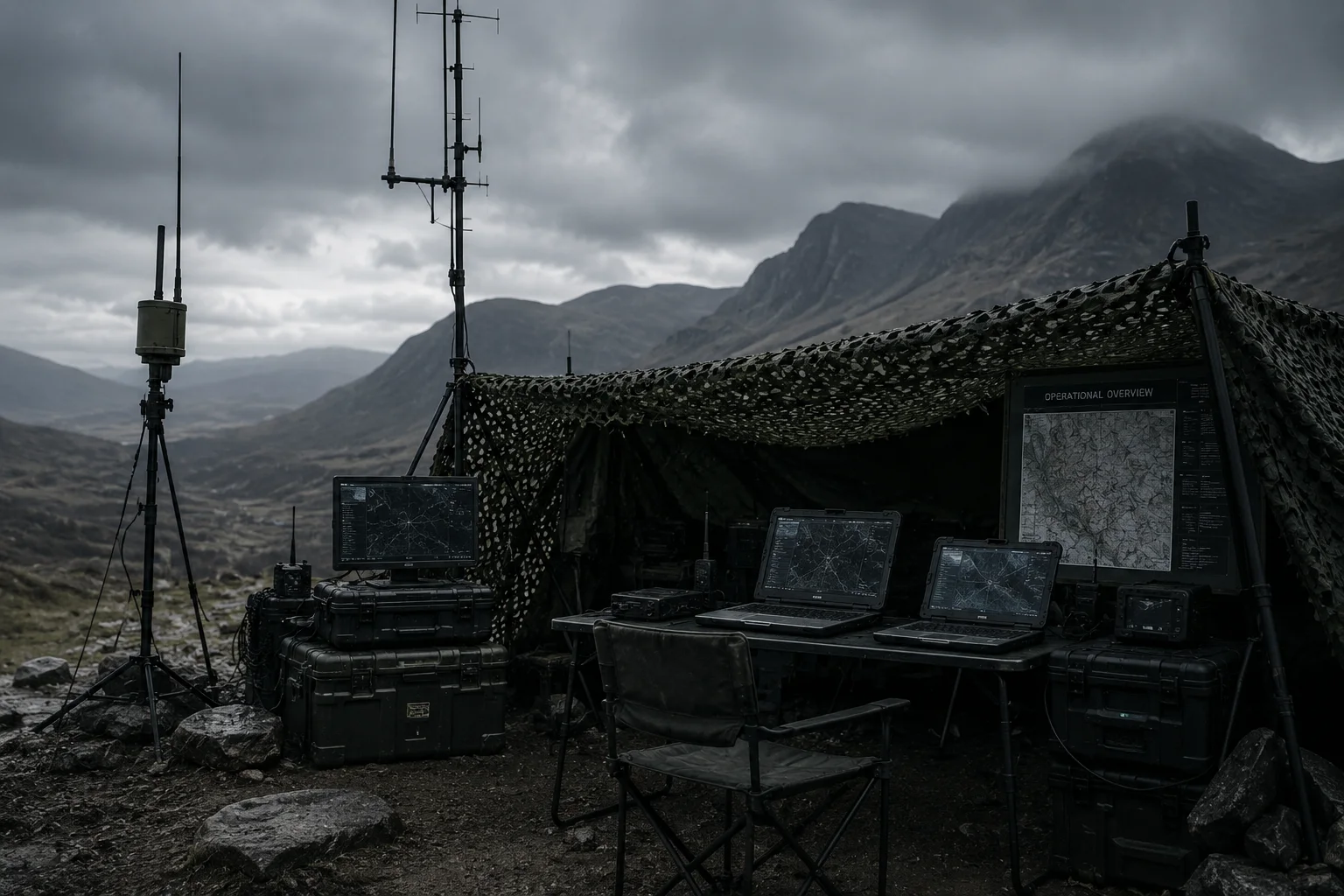
Relay is the airborne or elevated communications node in the Sentinel architecture. It bridges the operator’s ground segment to forward formations when terrain, distance or installation geometry makes a direct radio path insufficient.
Relay carries communications and Sentinel edge processing. It is infrastructure, not a combat platform.
The gap it closes
Ground radio links are constrained by line of sight, terrain masking and the position of the operator. An elevated node can see both sides of the link and bridge them without moving the command post into the forward operating area.
How it works
The ground segment maintains a long-haul link to Relay. Relay then participates in the local Sentinel mesh used by the forward formation. To the platforms, the node appears as their command and network path; to the operator, it returns formation state through the same system.
Relay can carry a local forwarding segment for Fusion and Command data. If the backhaul degrades, behavior remains bounded by the mission parameters already authorized. Search missions retain their prescribed abort or return behavior, and engagement authority is never created by the loss of a link.
Form factors
Airborne loitering node
Provides altitude and mobility for operations that need a moving relay between the GCS and a forward formation.
Multirotor node
Provides vertical takeoff and recovery where a compact elevated node is more important than fixed-wing persistence.
Tethered node
Provides sustained elevation and ground power for a defined operating site.
Mast-mounted node
Extends a fixed installation, Picket site, border position or Iris patrol area from a simple elevated structure.
The mission determines the carrier. The Sentinel network role is common across the form factors.
Use contexts
- Forward air formations operating behind terrain or outside direct ground-station line of sight.
- Wide fixed installations using Iris patrol assets.
- Maritime operations in which the command post remains ashore or in a protected area.
- Border and distributed Picket deployments.
- A UGV carrying a mobile ground relay.
Advantages
- Elevation converts a terrain problem into a manageable link-geometry problem.
- One network role can be hosted on airborne, tethered or ground-mounted carriers.
- Local forwarding preserves mission state through degraded backhaul without expanding authority.
- The same node connects air, ground, fixed-site and maritime operations.
Integration boundary
Relay transports authorized mission and command data; it does not create engagement authority. Command-plane controls, abort behavior and operator permissions remain enforced by Sentinel.