Ground segment
The operator stations, communications equipment, masts and antenna geometry used to command Tairos formations.
Configurations
Portable field cell
A portable operator and communications package.
Mission & capability
- Backbone
- Mission command and bounded authority
- Common operating picture
- Pilot control and supervision
- Type
- Configuration
- Domain
- Systems & Equipment
- System
- Ground segment
- Connected elements
- 04Components and integrations
Vehicle command post
A mobile operator, radio and antenna package.
Mission & capability
- Backbone
- Mission command and bounded authority
- Common operating picture
- Pilot control and supervision
- Type
- Configuration
- Domain
- Systems & Equipment
- System
- Ground segment
- Connected elements
- 04Components and integrations
Fixed-site installation
A fixed command package for sites such as Picket installations.
Mission & capability
- Backbone
- Mission command and bounded authority
- Common operating picture
- Pilot control and supervision
- Type
- Configuration
- Domain
- Systems & Equipment
- System
- Ground segment
- Connected elements
- 04Components and integrations
Portable field cell
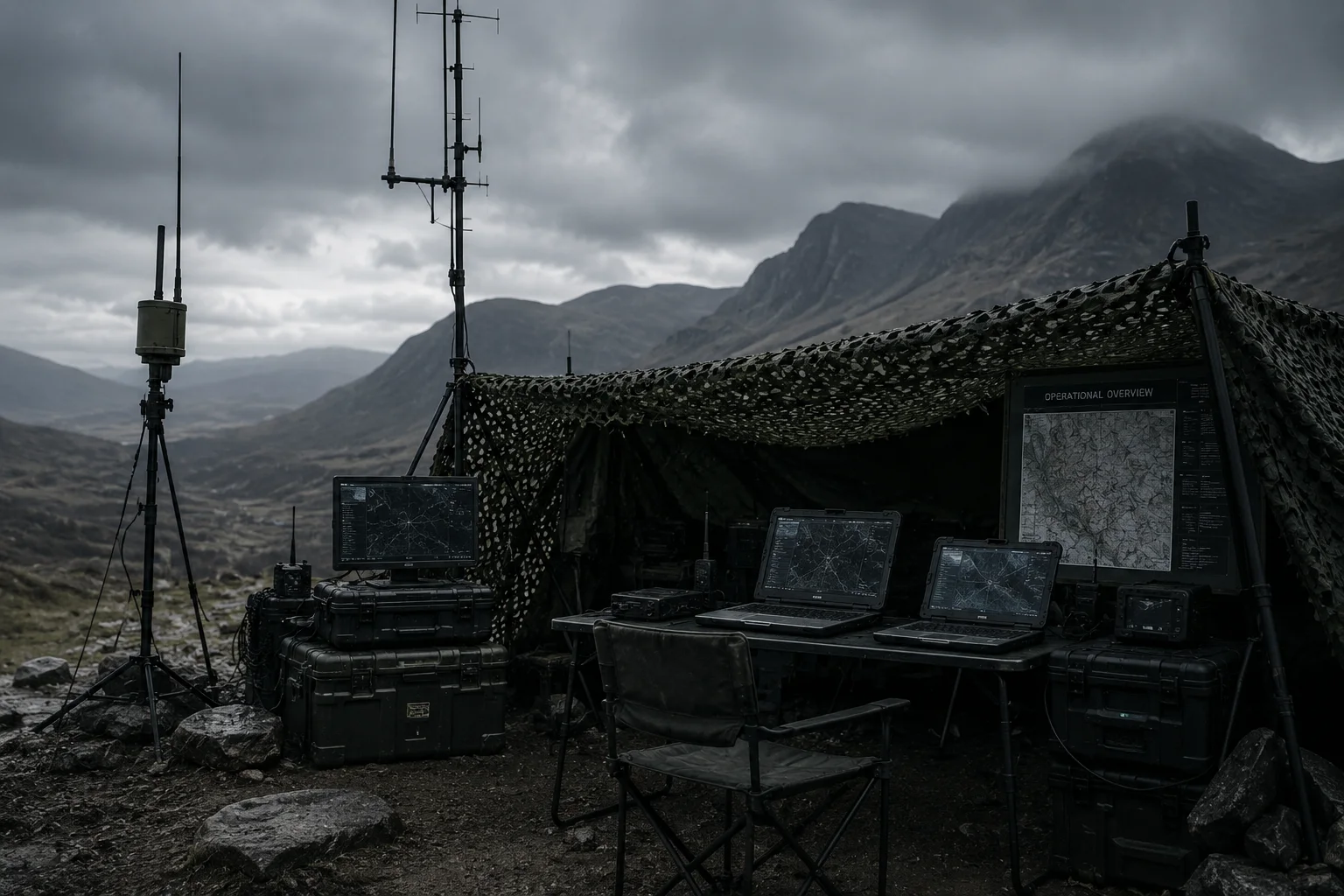
The Ground segment combines the operator station, communications equipment, antenna elevation and link geometry required to command Tairos platforms as a formation. It is packaged with the platform set and mission rather than treated as an afterthought to the airframe.
System elements
Ground control station
The GCS is the operator’s window into Panorama and Sentinel Command. It presents the common operational picture, supports mission planning and tasking, manages platform handoffs and provides positive-action authorization for engagements within the operator’s scope.
The operator surface can be configured as a portable rugged display, a laptop-class mobile station or a vehicle/shelter console according to formation size and command-post needs.
Communications box
The communications box contains the Tairos link equipment, amplification and filtering, antenna selection and link-management electronics. It connects the GCS to the formation and provides the ground endpoint for the Merlin radio stack.
Masts
Portable, vehicle-mounted and fixed-site mast configurations raise antennas above local obstructions. Height improves radio line of sight without adding complexity to the airborne platform.
Antennas
Directional antennas concentrate link energy toward the operating area and reject interference outside the main geometry. Omnidirectional coverage remains available where assets occupy several bearings, while diversity selection chooses the appropriate path from current link quality.
Two operator surfaces
| Operator | Primary surface | Responsibility |
|---|---|---|
| Mission commander | GCS tablet, laptop or console | Formation tasking, Panorama, network engagements and mission-level authority |
| FPV pilot | Merlin TX and Tairos FPV goggles | Direct flight, terminal supervision, airframe handoff and own-airframe authorization |
The roles can be combined in a compact team or separated as the formation and mission become more complex. Both remain connected to Sentinel Command and the same mission state.
The command boundary
Panorama provides the picture; the operator provides positive authorization; the communications box carries the command; the platform’s hardware gate enforces the authorized state. No engagement is created by a recommendation or by loss of a link.
Scalable deployment
The same package scales from a portable field cell to a vehicle command post or fixed Picket installation by changing the operator surface, antenna geometry and communications enclosure—not the underlying Sentinel operating model.
Advantages
- The operator, radio and antenna system is engineered as one link chain.
- Panorama presents mixed platforms and sensors on one surface.
- Directional geometry adds passive link resilience before active countermeasures are required.
- Portable, mobile and fixed-site configurations share the same command architecture.