EW soft-kill
Threat-matched electronic response directed by drone detection and Sentinel Fusion before a kinetic layer is committed.
Configurations
Directional mast
Fixed-site or approach-sector electronic protection.
Mission & capability
- Contest
- Electronic defeat
- Type
- Configuration
- Domain
- Systems & Equipment
- System
- EW soft-kill
Vehicle-mounted system
Electronic protection moving with a force or defensive belt.
Mission & capability
- Contest
- Electronic defeat
- Type
- Configuration
- Domain
- Systems & Equipment
- System
- EW soft-kill
Operator-carried system
A compact directed response for suitable close-in defense.
Mission & capability
- Contest
- Electronic defeat
- Type
- Configuration
- Domain
- Systems & Equipment
- System
- EW soft-kill
Directional mast
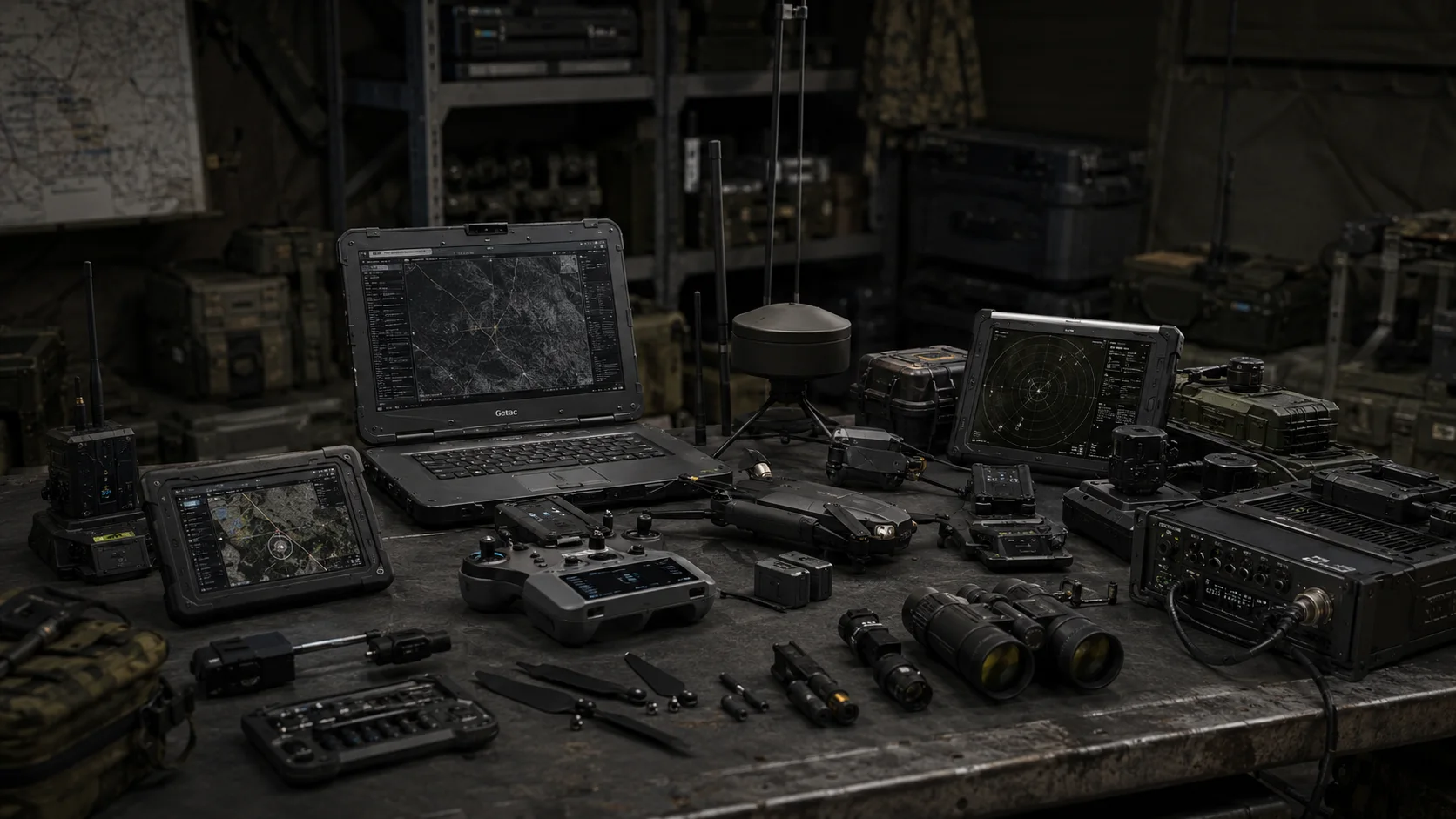
Tairos EW soft-kill equipment applies a threat-matched electronic response before a kinetic layer is committed. Drone detection and Sentinel Fusion provide the track and classification; the EW system directs the selected effect toward the known threat geometry.
Electronic defeat is one layer, not a universal answer. Picket escalates to another response when the target has no vulnerable link or when the electronic attempt does not produce the required outcome.
Response classes
| Response | Use | Boundary |
|---|---|---|
| RF link disruption | Breaks an active control or video link and triggers the target’s own link-loss behavior | Does not affect a vehicle with no active control link |
| Navigation disruption | Denies satellite-navigation reception in the selected area | Requires friendly-force and civil-system deconfliction; does not guarantee defeat of inertial or visually aided systems |
| Navigation deception | Introduces misleading navigation information to a compatible receiver | Target- and receiver-dependent; requires tighter technical and legal control |
| Protocol intervention | Uses a known, compatible control protocol to command a target to stop, land or return | Does not apply to encrypted, unknown or linkless systems and requires a maintained protocol library |
The selected configuration can combine these response classes according to the threat set, legal environment and customer rules.
Sentinel-directed application
Sentinel already holds the threat bearing and classification when the EW layer is invoked. That supports:
- directional application of energy toward the track rather than broad-area transmission;
- selection of a response suited to a linked, navigation-dependent or autonomous target;
- a visible engagement state in Panorama; and
- controlled handoff to a kinetic layer when required.
Deployment configurations
Directional mast
Protects a fixed site or known approach sector as part of Picket.
Vehicle-mounted system
Moves electronic protection with a deployed force or mobile defensive belt.
Operator-carried system
Provides close-in point or convoy defense where a compact directed response is appropriate.
Why layering matters
Control-link disruption can defeat remotely piloted drones but cannot stop every pre-programmed one-way aircraft. Navigation disruption can degrade some autonomous routes but can also affect friendly systems. A kinetic interceptor remains necessary for threats that survive or do not expose an electronic vulnerability.
Responsible use
Electronic effects are applied within authorized airspace, spectrum and mission rules. The operator retains oversight; Sentinel does not expand the authorized modality, target class or area. Friendly-system deconfliction, regulatory approval and program-specific end-user controls are required.