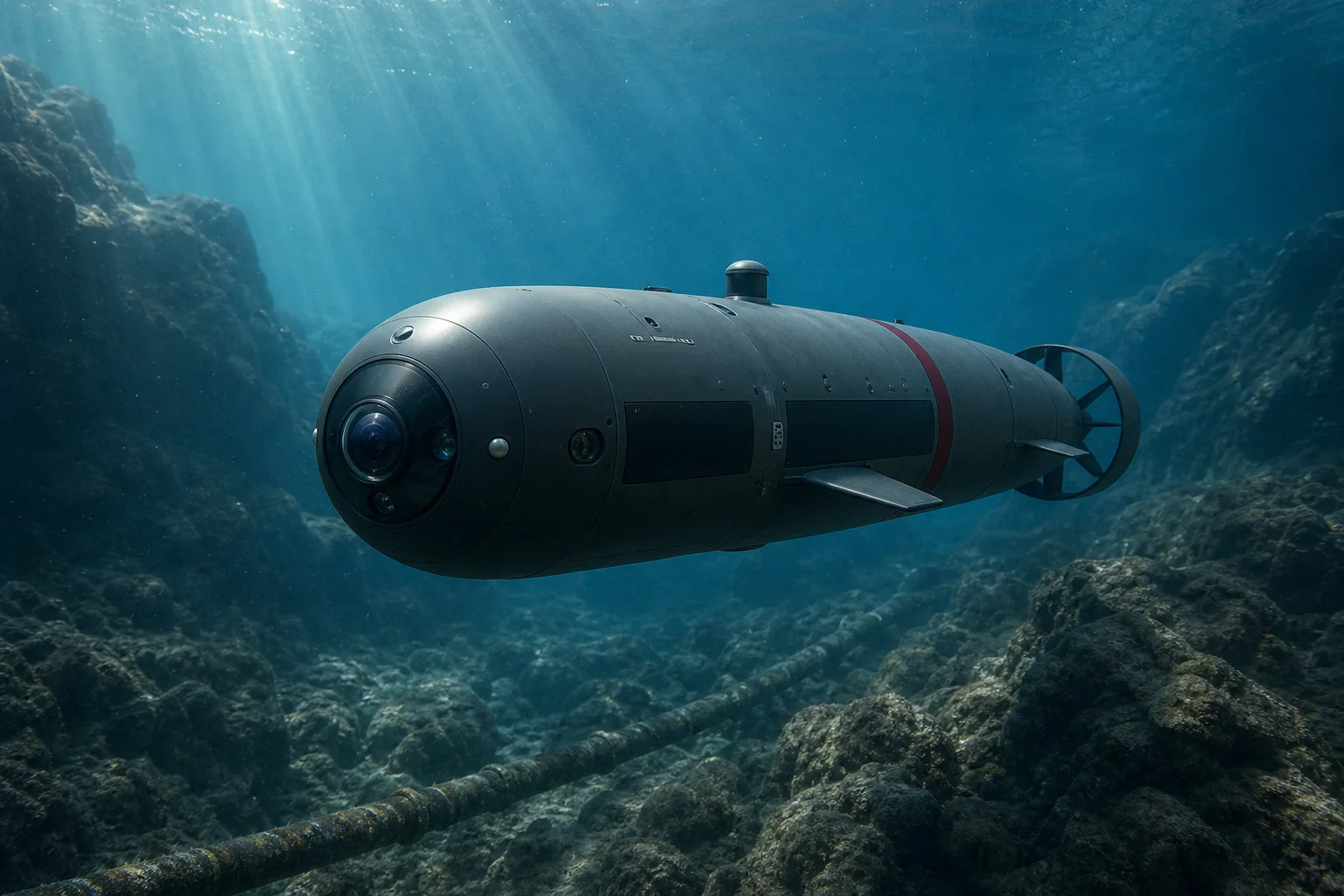
UUV
A concept family for autonomous and tethered undersea missions where continuous radio control is unavailable.
- Awareness
- Mine countermeasures
- Subsea inspection and infrastructure watch
- Maritime patrol and awareness
- Cross-domain network gateway
The Tairos UUV carries Sentinel into an environment where radio and satellite-navigation signals do not pass through the water. On autonomous missions, onboard execution, undersea navigation and deliberate communications windows replace continuous remote control. Tethered configurations retain a continuous path where inspection or intervention requires it.
Missions
Mine countermeasures
Detects, classifies and supports the neutralization of sea mines while reducing the need to place crews in the hazard area.
Seabed and infrastructure watch
Surveys cables, pipelines, approaches and other critical undersea infrastructure.
Harbor and port protection
Provides persistent underwater observation around ports, anchorages and fixed facilities.
Maritime awareness and anti-submarine support
Extends distributed sensing below the surface for survey, classification and networked search tasks.
Subsea inspection
Supports commercial and government inspection of offshore and underwater assets.
Autonomous and tethered configurations
An autonomous underwater vehicle executes an untethered mission within an operator-defined envelope. A remotely operated vehicle uses a tether where continuous control, power or high-bandwidth inspection data is required. The mission determines the control shape.
How the undersea system works
- Navigation: inertial navigation combines with Doppler velocity measurement and acoustic positioning; a satellite-navigation fix is available only at the surface.
- Communications: acoustic links serve low-bandwidth, higher-latency exchanges underwater; short-range optical links or a tether serve selected use cases.
- Edge autonomy: onboard compute carries the mission through intervals without a continuous link.
- Surface gateway: a USV or Relay-style surface node bridges undersea mission data back into Sentinel Mesh and Command.
Advantages tied to the architecture
- The mission does not depend on continuous radio contact.
- Surface and submerged assets share one mission picture when a communications path is available.
- Autonomous and tethered configurations cover distinct operational and inspection needs.
- The surface gateway links the undersea platform with shore command and Tairos air assets.
Mission authority and boundaries
The operator defines time, geography, target class, rules and fallback behavior before an autonomous mission begins. Abortability and end-user controls remain part of the system design. Any effect configuration requires explicit human authorization.