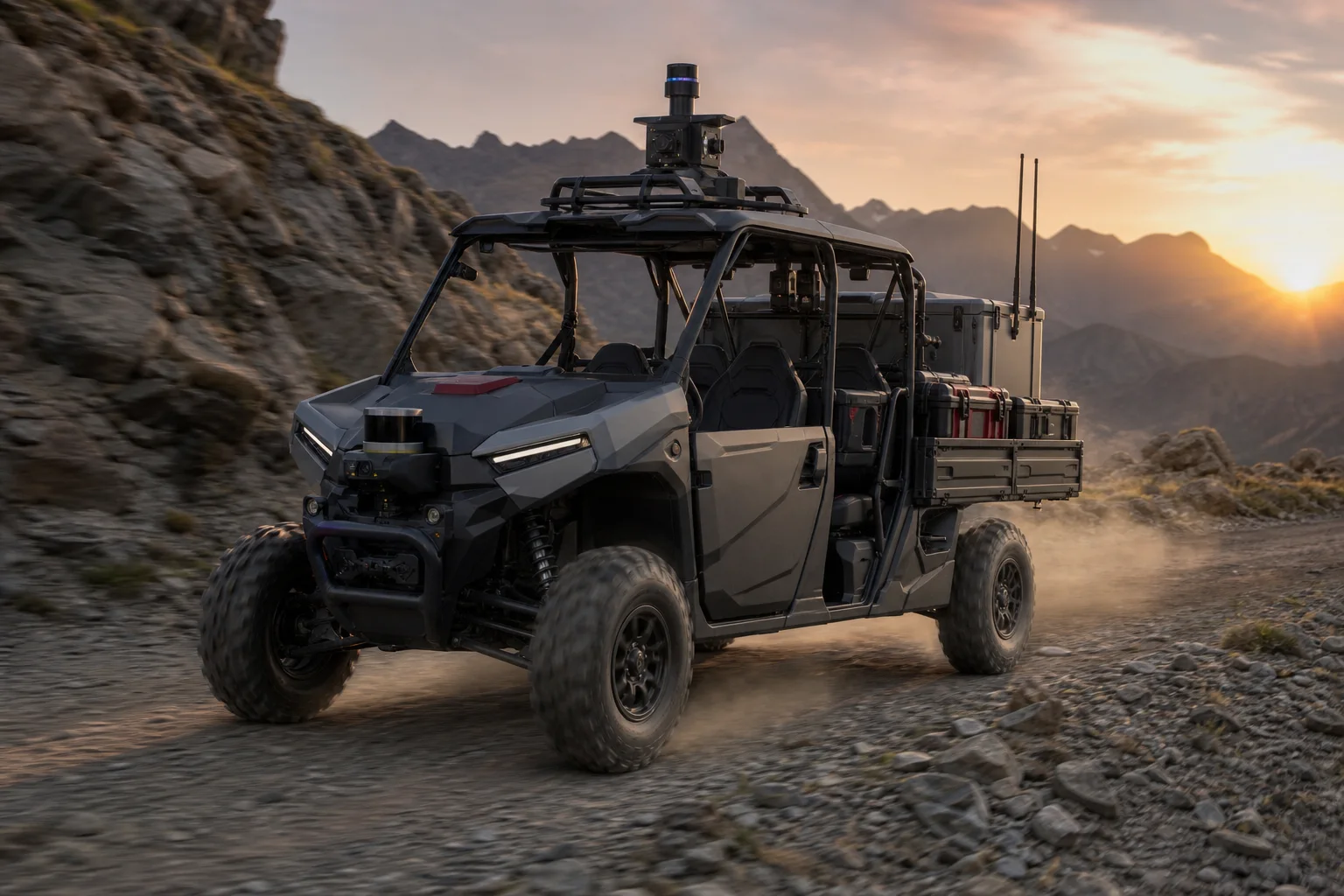
UGV
A utility-vehicle-based concept family for sustainment, sensing, communications and mobile mission support.
- Sustain
- Awareness
- Backbone
- Effect
- Forward logistics
- Casualty evacuation
- Platform carriage and launch support
- Reconnaissance and ISR
- Communications relay
- Mobile mission support
The Tairos UGV is a utility-vehicle-based unmanned ground platform for sustainment, sensing, communications and mission support. It retains the mobility and service ecosystem of an established vehicle class while adding a Tairos drive-by-wire, compute, sensor and payload-integration stack.
The operator problem
Forward movement is often the most dangerous part of a mission. Supplies must reach exposed positions, casualties must move back, sensors and communications must move with the force, and aerial systems need power, carriage and launch support closer to the point of use.
The UGV puts the vehicle in that risk envelope while keeping the operator at a controlled distance.
Configuration and operating model
The platform combines four elements:
- a utility-task vehicle chassis selected for the operating environment;
- drive-by-wire actuation for steering, throttle and braking;
- onboard power, compute and sensing for teleoperation and Sentinel Edge functions; and
- a modular mission deck for payloads, cargo and support equipment.
The Tairos conversion stack is the common layer. It can be adapted to an appropriate vehicle base without rebuilding the mobility system from first principles.
Mission configurations
Forward logistics
Carries ammunition, batteries, water and other supplies into exposed areas.
Casualty evacuation
Provides an uncrewed route for moving wounded personnel out of danger while reducing risk to an additional crew.
Drone carrier
Carries, launches and supports Dart and Strix-family air systems from a mobile forward position.
Mobile awareness node
Carries an elevated sensor package or Iris-derived sensing equipment to extend observation from a moving ground base.
Communications node
Mounts Relay equipment to extend Sentinel networking and command reach from the ground.
Hazardous-route and effect configurations
Supports route or mine-clearance equipment and remotely operated mission payloads. Any armed configuration remains subject to positive human authorization and Tairos end-user controls.
Why the architecture matters
- Proven mobility underneath. Engineering effort is concentrated on control, sensing and integration rather than recreating the vehicle.
- One vehicle, multiple mission kits. The mission deck changes the role without requiring a separate ground platform for each task.
- A ground node in the Tairos fleet. Sentinel connects the UGV with air platforms, Relay and the operator system.
- Risk moves away from the crew. The vehicle performs movement and carriage tasks inside hazardous areas.
Sentinel and operator integration
Sentinel Edge supports onboard control and mission execution. Mesh and Relay connections return platform state to the operator and connect the UGV with nearby air assets. Mission parameters, abort behavior and any effect authorization remain bounded by Sentinel Command.
Responsible control
Armed mission kits use human-in-the-loop engagement authorization, a hardware-level ARM-ENABLE boundary and mission-abort capability. Engagement authority does not propagate laterally from another vehicle or airframe. Delivery is limited to legitimate end users under program-specific controls.