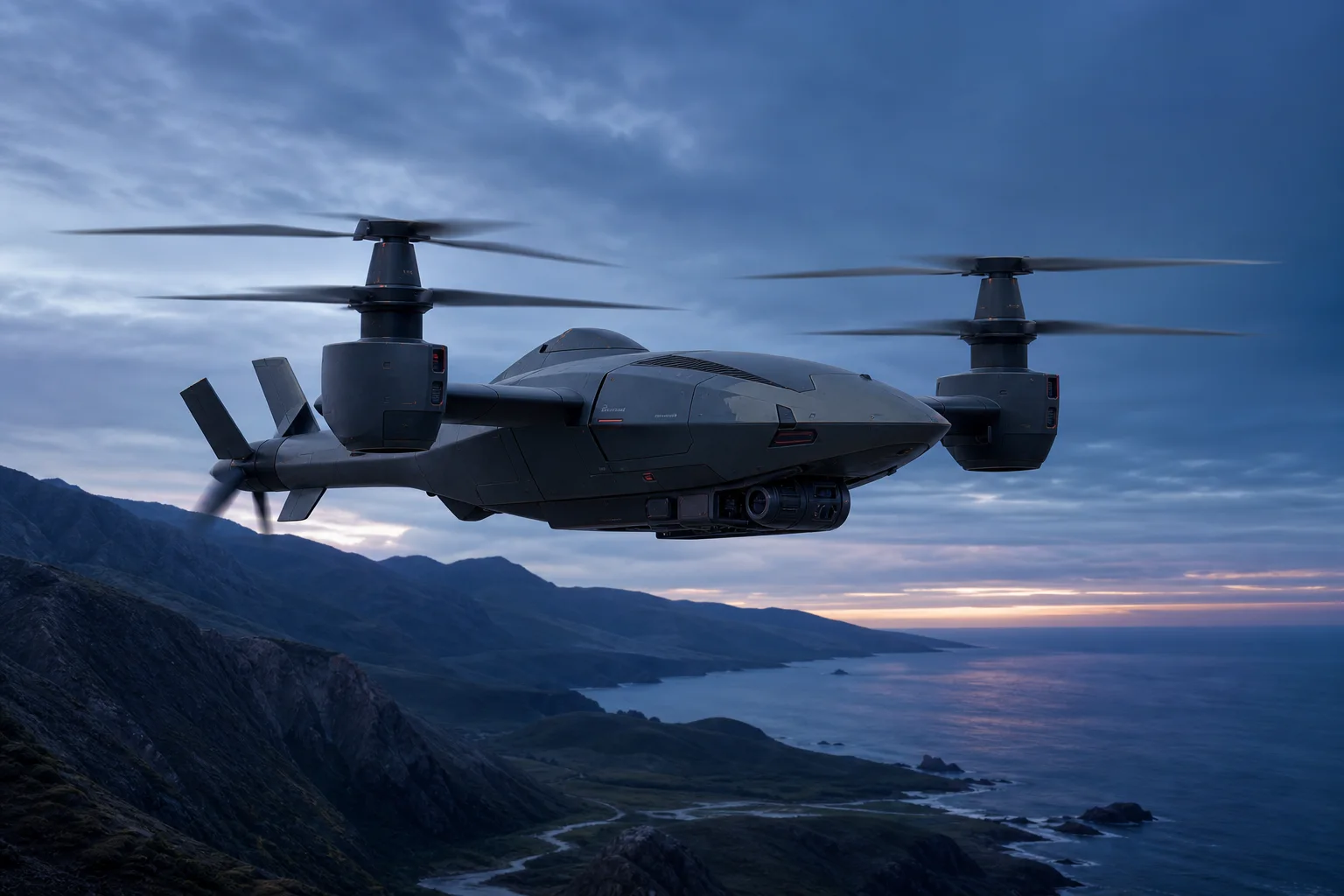
Milvus
A compound VTOL platform combining coaxial lift rotors with a dedicated rear propulsor for mission work.
- Awareness
- Sustain
- Backbone
- Reconnaissance and ISR
- Communications relay
- Forward logistics
- Modular mission carriage
Compound VTOL for lift, transit and persistent mission work.
Milvus combines counter-rotating coaxial lift rotors with a dedicated rear propulsor. It takes off, lands and holds vertically, then separates forward-flight thrust from the lift-rotor task during transit.
The operational problem
Some missions need to launch from constrained ground or a ship deck, hold over a point and also cover distance with useful mission equipment. A conventional fixed-wing aircraft cannot launch and recover vertically; a conventional helicopter uses its main rotor for both lift and forward propulsion.
Milvus brings those requirements into one compound airframe and connects the vehicle, mission payload and operator through Sentinel.
Airframe architecture
- Coaxial lift system: counter-rotating rotors provide vertical launch, landing and hover without a tail rotor.
- Forward propulsor: a separate rear propulsor supplies forward thrust instead of asking the lift rotors to provide the entire transit function.
- Mission interfaces: sensor, communications, cargo and authorized mission equipment are fitted around the same vehicle architecture.
- On-platform control: Sentinel coordinates navigation, vehicle state, operator-defined mission boundaries and the transition between vertical and forward flight.
Configurations
Workhorse configuration
The workhorse configuration uses the coaxial rotor and rear propulsor without a fixed wing. It is the general-purpose Milvus platform for logistics, ISR, communications support and mission carriage from dispersed locations.
Shipborne configuration
The shipborne configuration adds wing lift for forward transit and folding-rotor integration for deck operations. It supports maritime ISR, logistics and mission carriage where runway infrastructure is unavailable.
Mission roles
Persistent ISR and communications support
Milvus carries sensor or communications packages to an assigned area, holds where the mission requires vertical station-keeping and shares the resulting picture through Sentinel.
Contested logistics
The platform carries cargo between dispersed points and places it vertically, reducing dependence on a runway or prepared landing strip.
Shipborne operations
Vertical launch and recovery let Milvus operate from deck space that cannot support conventional fixed-wing operations. The same platform can carry surveillance, communications or logistics equipment according to the mission configuration.
Mission carrier
Milvus carries sensor, communications, cargo or authorized effect equipment in mission-specific configurations. The platform remains part of the common Tairos command, authorization and abort architecture.
Why Milvus
- Vertical access and forward transit: lift and forward propulsion are assigned to distinct mechanisms within one airframe.
- Useful hover: the coaxial rotor system supports observation, delivery and station-keeping at the mission point.
- Role flexibility: the same vehicle architecture supports sensor, communications, cargo and authorized mission-equipment configurations.
- Distributed operation: vertical launch and recovery reduce dependence on fixed runway infrastructure.
- Common command system: Sentinel connects Milvus to operators, sensors, network nodes and the wider portfolio.
Responsible control
Operators define the mission boundaries and authorize ARM-ENABLE. Antipersonnel effects require in-loop human authorization for each engagement. Mission abort cannot be disabled; a comms-denied search mission returns to base. Engagement authority does not transfer laterally between platforms.