Model
Strix 20
The twenty-inch heavy member for formation leadership, reconnaissance, lift and heavy-effect configurations.
Mission fit
- Effect
- Awareness
- Sustain
- Backbone
- Airframe class
- Twenty-inch FPV-origin multirotor
- Propulsion layouts
- X4 and X8 configurations
- Structure
- Carbon-fiber airframe with folding arms
- Roles
- Formation lead, reconnaissance, lift and authorized effect
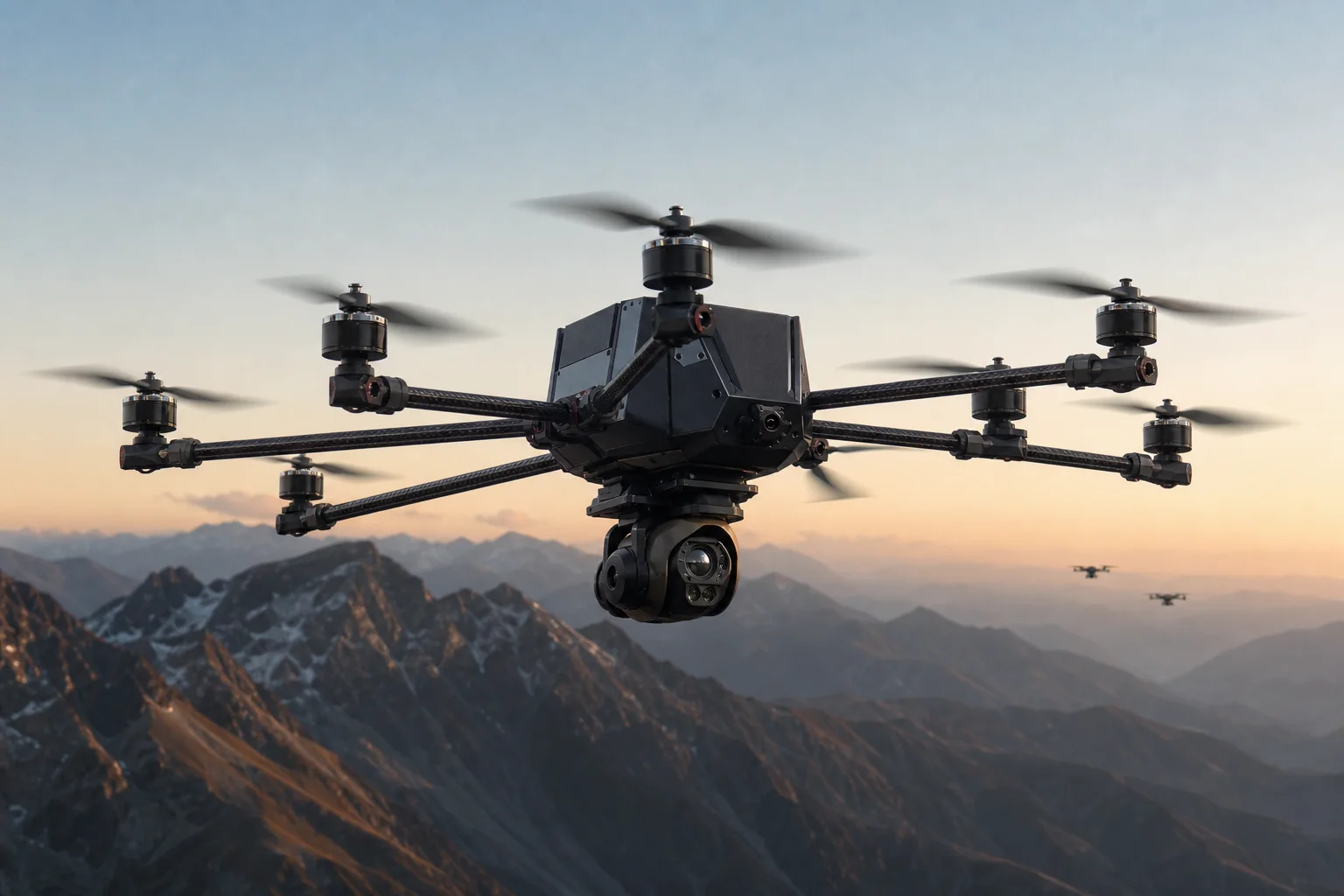
The twenty-inch heavy member of Strix, combining mission capacity with formation leadership.
Strix 20 carries the heavy Sentinel package and serves as a reconnaissance, lift, heavy-effect or mixed-cell lead aircraft. X4 and X8 configurations let the operator balance airframe simplicity against additional lift and propulsion redundancy.
Mission role
Strix 20 exists for the missions that exceed the physical and coordination envelope of the smaller Strix members. It carries the family’s broadest sensor and compute package, aggregates observations from a mixed cell and distributes operator-approved tasking to subordinate aircraft.
The aircraft can serve three public mission paths:
- Formation lead: fuses the local picture and coordinates Strix 10 and Strix 15 aircraft through the Sentinel mesh.
- Reconnaissance and lift: carries a heavy sensor or utility package and returns for repeated use.
- Authorized effect: carries a heavy-tier effect module while preserving human authorization for each engagement.
Airframe configurations
The base aircraft uses a twenty-inch multirotor layout with a carbon-fiber structure and folding arms.
- X4 configuration: the simpler four-motor layout for missions that prioritize lower mass and mechanical simplicity.
- X8 configuration: a coaxial eight-motor layout for missions that prioritize additional lift and propulsion redundancy.
Both configurations use the same heavy-tier Sentinel, mission-interface and operator concepts.
Formation leadership
Strix 20 combines onboard EO and thermal sensing with visual mapping and mesh coordination. It maintains the local formation picture, assigns operator-approved tasks to other Strix members and provides a single supervisory view to the ground operator.
The mesh is not a route for autonomous escalation. If another aircraft assumes the lead role, sensor and coordination state can move with it, but engagement authority remains at the command boundary.
Key advantages
- Formation-level capacity: onboard sensing, mapping and mesh functions support mixed-aircraft coordination.
- Configurable propulsion: X4 and X8 layouts address different lift and redundancy priorities.
- Heavy mission interface: approved reconnaissance, utility and effect packages share a common integration discipline.
- Onboard sensor fusion: electro-optical and thermal inputs build a richer local picture.
- Visual mapping: onboard visual navigation supports operation when satellite positioning is degraded.
- Cross-portfolio handoff: tracks and mission state can pass from the local Strix layer to other Sentinel-connected platforms.
Sentinel relationship
Strix 20 carries the heavy Sentinel Edge tier and leads the local mesh and fusion functions. It turns the Strix family from a set of individual aircraft into a coordinated formation while keeping the operator at the authorization boundary. Mission abort remains available, and lethal authority never propagates laterally across the cell.
Public configuration
| Attribute | Public description |
|---|---|
| Airframe class | Twenty-inch FPV-origin multirotor |
| Propulsion layouts | X4 and X8 configurations |
| Structure | Carbon-fiber airframe with folding arms |
| Roles | Formation lead, reconnaissance, lift and authorized effect |
| Sensing | EO and thermal sensing with visual mapping |
| Mission interface | Heavy-tier modular interface with hardware authorization boundary |