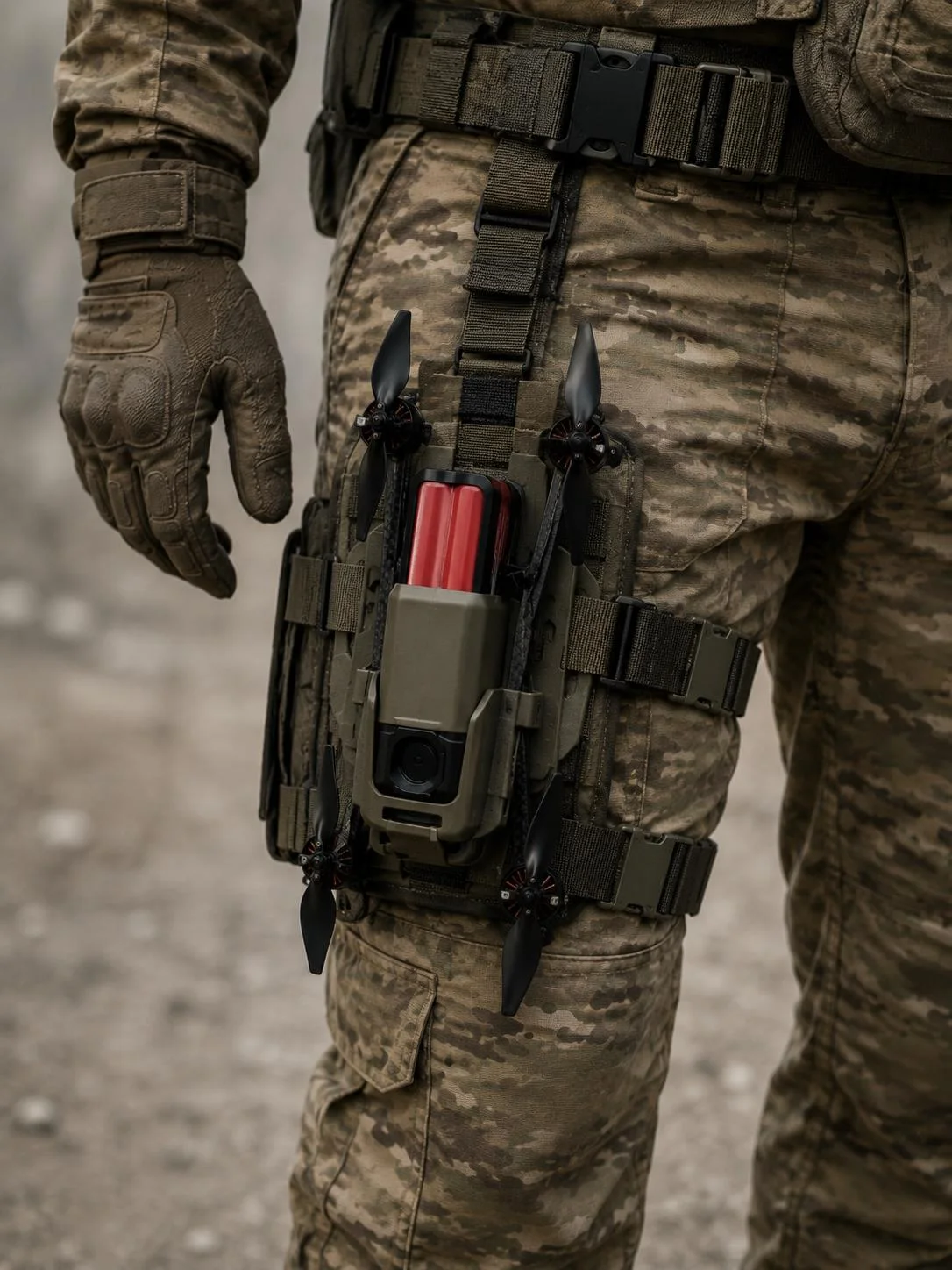
Dart
A five-inch, vest-carried multirotor for local reconnaissance and authorized precision effect at the infantry edge.
- Effect
- Awareness
- FPV effect
- Reconnaissance and ISR
A five-inch, vest-carried aircraft for reconnaissance and authorized precision effect at the infantry edge.
Dart places a compact air vehicle with the supported unit. It launches without a runway, tripod or separate launcher and carries either a small ISR head or an effect module on the same airframe.
Organic air capability
Small units often depend on assets located farther up the chain for observation and precision effect. Dart keeps the aircraft, operator interface and mission equipment with the team that needs them. Its compact carbon-fiber airframe and multirotor configuration support close terrain, urban approaches and confined launch locations.
Configuration and operating model
Dart uses a five-inch multirotor airframe with a single-axis pitch imaging head. A low-light electro-optical camera and onboard illumination support observation in changing light conditions. Optical flow, inertial sensing and short-range altitude sensing provide a navigation path that does not rely on satellite positioning alone.
The aircraft is available in two mission configurations:
- ISR configuration: a compact sensor head for observation, route inspection and local reconnaissance.
- Effect configuration: an authorized mission-effect module connected through the small-tier modular interface.
Onboard mission functions
Sentinel Edge executes navigation, visual tracking and terminal mission logic on the aircraft. Once the operator identifies and authorizes the mission object, the onboard system can maintain the track during link degradation. Keeping these functions aboard the aircraft reduces dependence on continuous remote compute or a clean radio path.
Why Dart
- Carried with the unit: the five-inch form factor keeps the aircraft close to the infantry team.
- No dedicated launch equipment: multirotor launch supports dispersed use from constrained locations.
- One airframe, two roles: ISR and effect modules use the same compact platform.
- Navigation without a single dependency: optical, inertial and altitude inputs complement the operator link.
- Common Tairos architecture: Sentinel and the modular interface connect Dart to the wider portfolio rather than leaving it as an isolated micro-drone.
Operator authority and abort
The effect configuration uses human-in-the-loop authorization. A hardware boundary separates effect authorization from flight software, and the operator retains mission-abort authority. Dart does not autonomously select and engage individual people.
Related systems
Dart is the smallest member of the FPV-origin line. Strix adds larger airframe classes and formation roles; Apex provides reusable direct-fire and launched-effect configurations. All three connect through Sentinel.