Model
Strix Opto
A fiber-controlled Strix member for missions requiring an RF-silent airborne control and video path.
Mission fit
- Effect
- Awareness
- Link
- Single-mode fiber for control, video and telemetry
- Variants
- Short, Standard, Long and Extended
- Navigation
- Optical and inertial inputs with onboard Sentinel
- Roles
- Reconnaissance and authorized effect in RF-constrained environments
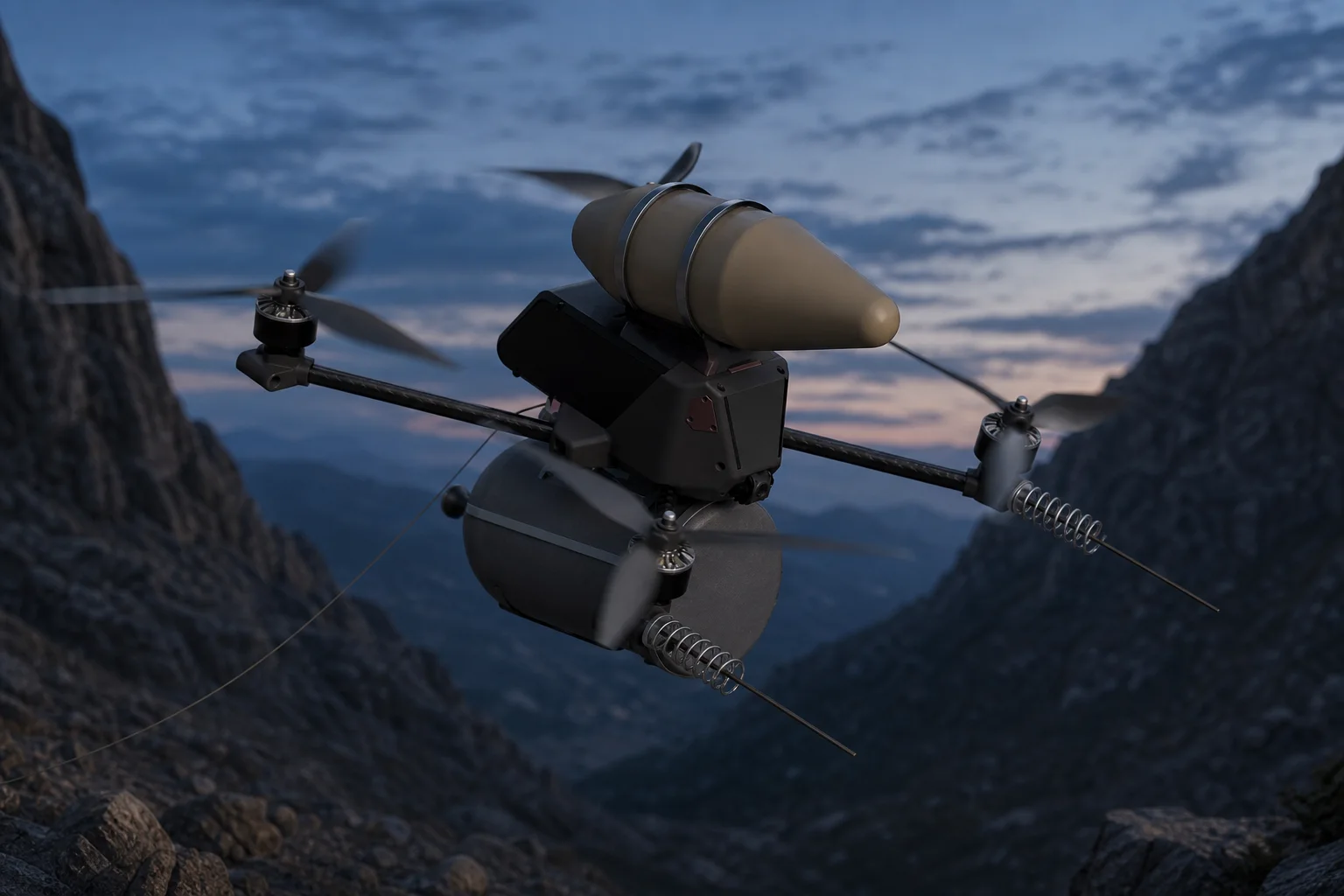
Fiber-controlled Strix aircraft for missions that require an RF-silent airborne control and video path.
Strix Opto replaces the airborne radio control and video links with single-mode fiber. Control, video and telemetry share the tether, while navigation, target tracking and terminal mission logic continue to run aboard the aircraft.
The operational gap
Radio-controlled aircraft must manage interference, jamming and the fact that every transmission can become a signature. Fiber changes that equation. In its silent configuration, Opto carries no airborne radio control, video transmitter or telemetry transmitter. The control path cannot be denied through RF jamming because it does not use RF.
Fiber also creates its own constraint: the spool is a major part of the aircraft’s mass and geometry. Opto therefore begins with the tether requirement and builds the airframe around it.
Four spool-defined variants
Strix Opto is one product line with four spool-defined variants:
- Short: compact airframe and spool for close, constrained missions.
- Standard: the balanced workhorse for general fiber-controlled operations.
- Long: a larger airframe and energy package for increased tether reach.
- Extended: the largest spool and aircraft configuration in the line.
The labels identify operating scale without embedding a distance claim in the product name. Each variant matches airframe, propulsion, battery and mission-equipment capacity to its spool rather than treating fiber as a retrofit.
Common platform architecture
Every Opto variant combines:
- single-mode fiber carrying control, video and telemetry;
- a controlled spool with tension and break monitoring;
- onboard Sentinel Edge compute for navigation, tracking and terminal mission logic;
- optical and inertial navigation for the RF-silent operating mode;
- a tier-matched modular mission interface; and
- the direct multirotor flight character of the Strix family.
Link-loss continuation
The tether is the operator’s path to the aircraft, not the location of its mission logic. If the fiber is cut after the operator has authorized and established a terminal track, Sentinel can continue the bounded terminal phase from onboard state. If no authorized terminal mission is active, the aircraft follows its configured abort behavior.
Key advantages
- No airborne RF control or video transmission in silent configuration: the aircraft removes the radio path that RF jammers and direction-finding systems depend on.
- Spool-first engineering: airframe and energy capacity are matched to the tether rather than burdened by a retrofit.
- Mission logic onboard: tether loss does not remove navigation or authorized terminal logic from the aircraft.
- Common Strix operator model: the airframe preserves the same family flight and mission concepts.
- Tier-matched mission equipment: compatible reconnaissance and effect modules use the same modular-integration discipline as RF Strix members.
Operator authority
Opto remains human-in-the-loop for lethal effect. Tether loss does not create new engagement authority; it only permits the aircraft to complete a previously authorized, bounded terminal action. Mission abort and effect authorization remain protected functions.
Public configuration
| Attribute | Public description |
|---|---|
| Link | Single-mode fiber for control, video and telemetry |
| Variants | Short, Standard, Long and Extended |
| Navigation | Optical and inertial inputs with onboard Sentinel |
| Roles | Reconnaissance and authorized effect in RF-constrained environments |
| Mission interface | Tier-matched modular interface with hardware authorization boundary |